
Mappit Games: Built From What Actually Happened Today
Where’s Marco, Bullshit, and Conquest are live on Mappit. Every clue, every question, and every province traces back to a real story.
You know the feeling. You open the feed to find out what happened today, and forty minutes later you know less than when you started, you feel worse, and you couldn’t say which of it mattered. The scroll is built to be endless. It is not built to leave you informed.
We built the opposite. Mappit already turns the world’s news into a living map — hundreds of cities, every story pinned to the place it is about, corroborated across independent AI sources, with every link checked. Now that map is a playing field. Three games, each drawn fresh from the day’s real stories. Play them, and you’ll know what happened today without ever opening a feed.
Here is the promise behind all three: nothing in them is invented. A riddle in the treasure hunt was written this morning from a story that ran this morning. The “fake” you’re hunting in Bullshit is a real summary with exactly one fact bent. The provinces on the Conquest board are the cities the world’s press covered most this week, and their economies rise and fall with how much those cities are in the news. Every reveal links to the real storyline. The games are hard precisely because the only winning strategy is to actually follow the news.
Where’s Marco — the daily treasure hunt
Marco is Mappit’s resident guide, and every morning he goes missing. Five riddles, written fresh from the day’s news, lead you city to city across the map. Solve the first, fly there, zoom in to claim the find, and the next riddle unlocks — along with the real story it was written from and a link to the storyline. Five clues, and the trail ends at Marco himself, whose actual pin on the map has moved to the day’s final location.
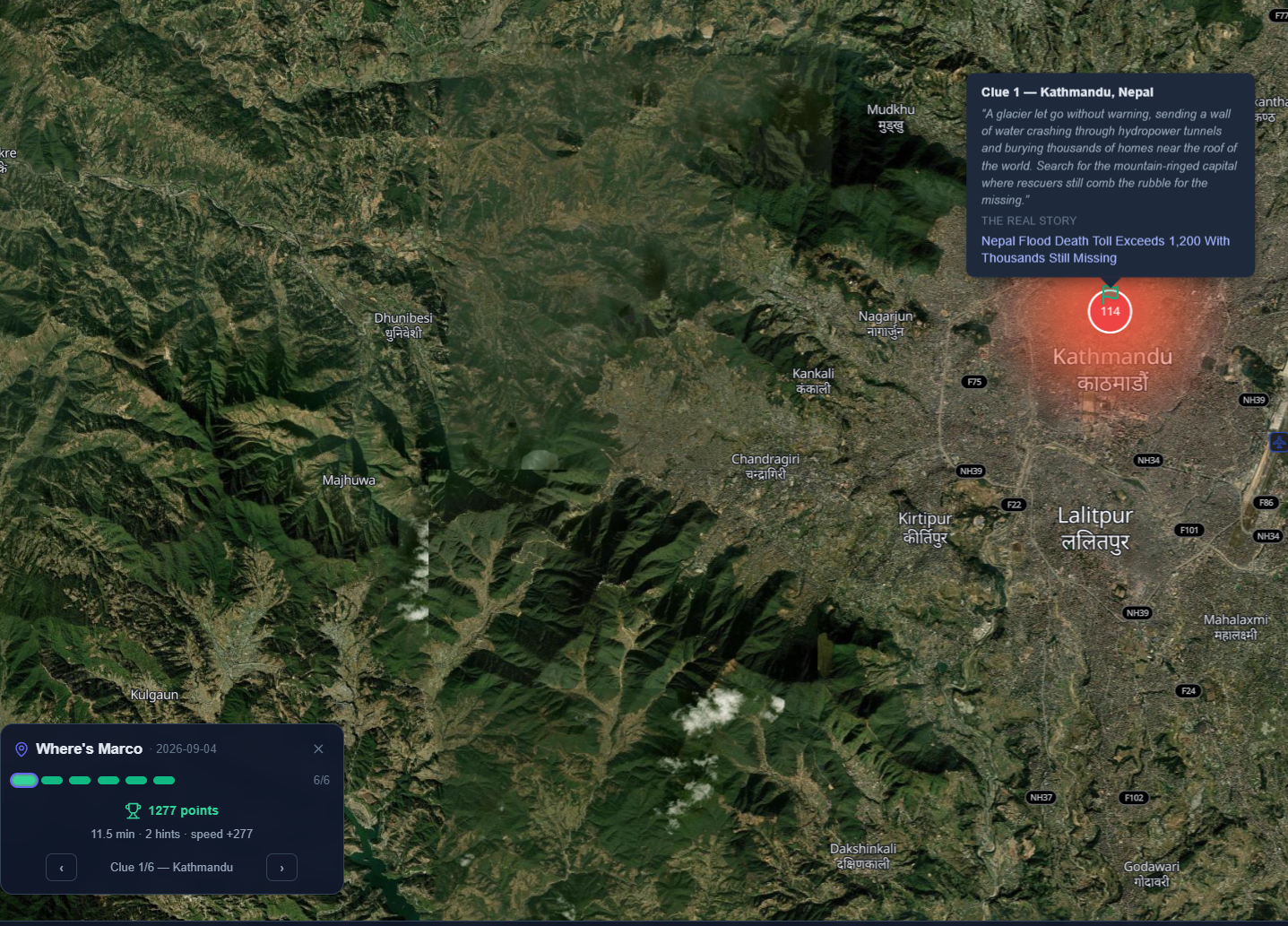
The riddles reward two kinds of knowledge at once. You need the geography (which coast, which capital, which river city), and you need the news (what happened there today that a riddle would hinge on). A clue about a port city that lost a cargo ship overnight is unsolvable if you didn’t hear about the collision, and obvious if you did. That is the point. By the time you find Marco you have read five stories from five places on the planet, and you remember them, because you had to think.
Scoring: 100 points per find, a 500-point bonus for finishing the trail, and a speed bonus of up to 300 points that shrinks by 2 points per minute — the fastest hunters take the most. Stuck? Hints cost 50 points each: the first reveals the clue’s country, the second makes the target glow on the map. A new hunt publishes early every morning at 2:30 AM Pacific (5:30 AM Eastern, so East-coast coffee comes with a fresh trail). Yesterday’s hunt closes at midnight Pacific and reveals its full route and every story behind it.
Bullshit — spot the fake
Four real news summaries from this week. Three are exactly as reported. One has had a single fact quietly bent — an actor swapped, a number changed, a place moved, an outcome inverted. You have 1 minute from the moment you flip the cards. Find the fake.
This is the game for people who think they follow the news. It is humbling. A summary can be ninety-five percent correct and still be the lie, and the thing that gives it away is a detail: the minister’s name, the size of the fine, which side of the border. Play a week of it and you start reading everything differently — not “does this sound right?” but “which fact would I check?” That is a media-literacy reflex, and there is no faster way to build it than being wrong on a 1-minute clock and seeing the reveal: “Bolsonaro → Haddad”, with the real storyline one click away.
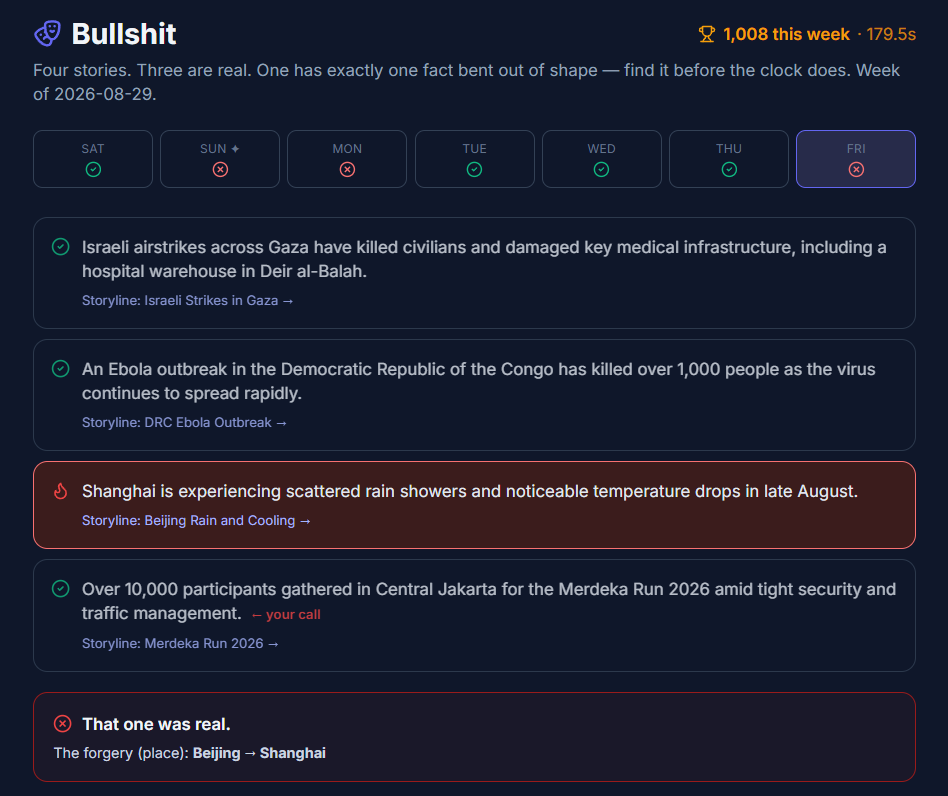
The rhythm: a new round unlocks every morning at 8 AM Pacific, together with Mappit’s Daily Digest, Saturday through Friday — seven rounds a week. Read the brief, then spot the fake. Miss a day and you can play it later; the clock only starts when you choose to view a round. Sunday’s round is special: it plays against history, with real historical events in place of the week’s news.
Scoring: a correct call earns 250 points plus up to 750 more the faster you answer. The clock is real — answer after the 30 seconds run out and even a correct call scores zero. Call all seven rounds in a week correctly, within the clock, and a +1,000 streak bonus lands on top.
Conquest — the weekly strategy game where the news is the weather
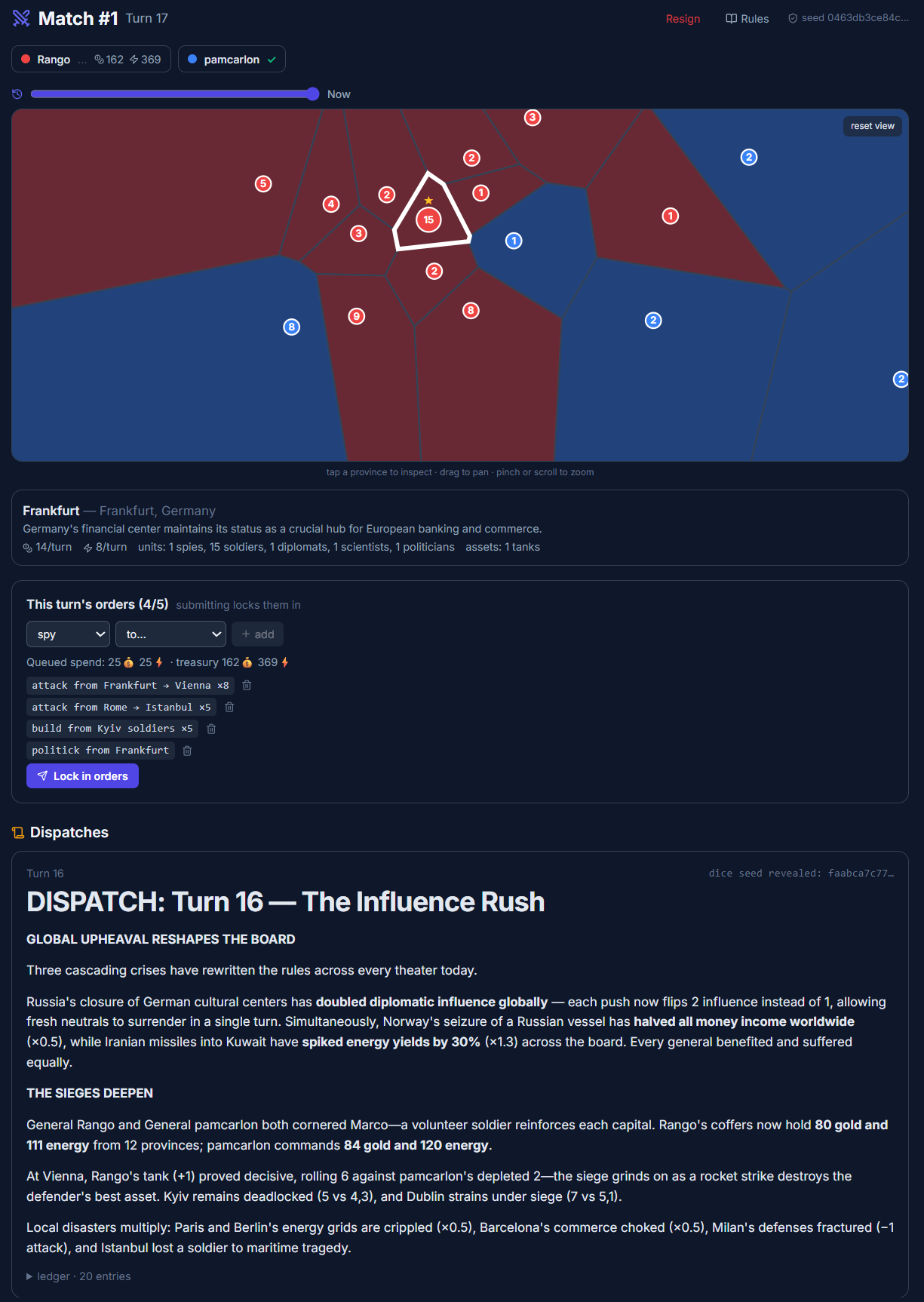
Conquest is the deep one. Every Saturday, the week’s most-covered news cities become a Risk-style board. Each city is a province with its borders drawn around it, sea lanes between the ones an ocean separates, and two to five generals fighting for the map. You submit orders, the table resolves, and a war correspondent files a dispatch. Then the world changes under your feet, because the world actually changed.
The news is the weather
Every province you hold pays money and energy each turn — multiplied by how much its storyline is trending today. A city in the headlines pays up to double; a quiet one pays base. That alone changes how you play: the province worth taking on Tuesday is the one whose news broke on Monday, and you learn to watch the map like a trader watches a ticker.
On top of that, three event cards are drawn each day from real stories and applied to the whole world: a summit story doubles diplomacy for everyone, a supply-chain story cuts money income across the board, a security story adds +1 to every attack. And beneath the global cards, local events strike individual provinces, drawn from that city’s own news: a wildfire cuts its energy output, civil unrest costs its garrison a soldier, relief convoys add one, a fortification story boosts its defenders. Local events apply only to their province, whoever holds it, and they follow the news — when the wildfire ends or the truce is signed, the effect simply stops appearing. Every card and every local event appears in the turn ledger with its story and its exact game effect.
Play a week of Conquest and you will know which cities were in the news this week, why, and roughly how it went — because your economy depended on it.
How a turn works
Each turn you submit up to five orders: move soldiers, attack a neighbor, influence a neutral province with diplomats, sabotage with spies, build units, buy assets, or politick for extra income. Submitting locks your orders — the table sees your checkmark, and the moment every living general has reported, the turn resolves. All orders resolve simultaneously in a fixed sequence (events, income, influence, builds, moves, attacks, outcome), and an eager table plays as many turns a day as it likes. A weekly match also gets a midnight-Pacific backstop resolution, so one absent player never freezes the war.
Five unit types (soldiers, diplomats, spies, politicians, scientists) and six assets (drones, tanks, ships, planes, satellites, rockets) give the game its texture. Ships open sea lanes, planes let a column move two provinces, tanks and drones sharpen an attack, satellites harden a defense, and a rocket destroys the defender’s most valuable asset before the dice are even rolled. Neutral provinces can be won without a shot: two turns of diplomatic pressure, or one under a diplomacy event card.
The dice are honest, and the ledger shows its work
Combat is Risk-style: the attacker rolls up to three dice, the defender up to two, top die against top die, ties to the defender. An assault rolls round after round until it is decided — either the column you committed is spent, or the last defender falls and every survivor marches in. The number you commit is the size of the occupying force, minus losses, so a big column can grind through a garrison in one night where a small one would break.
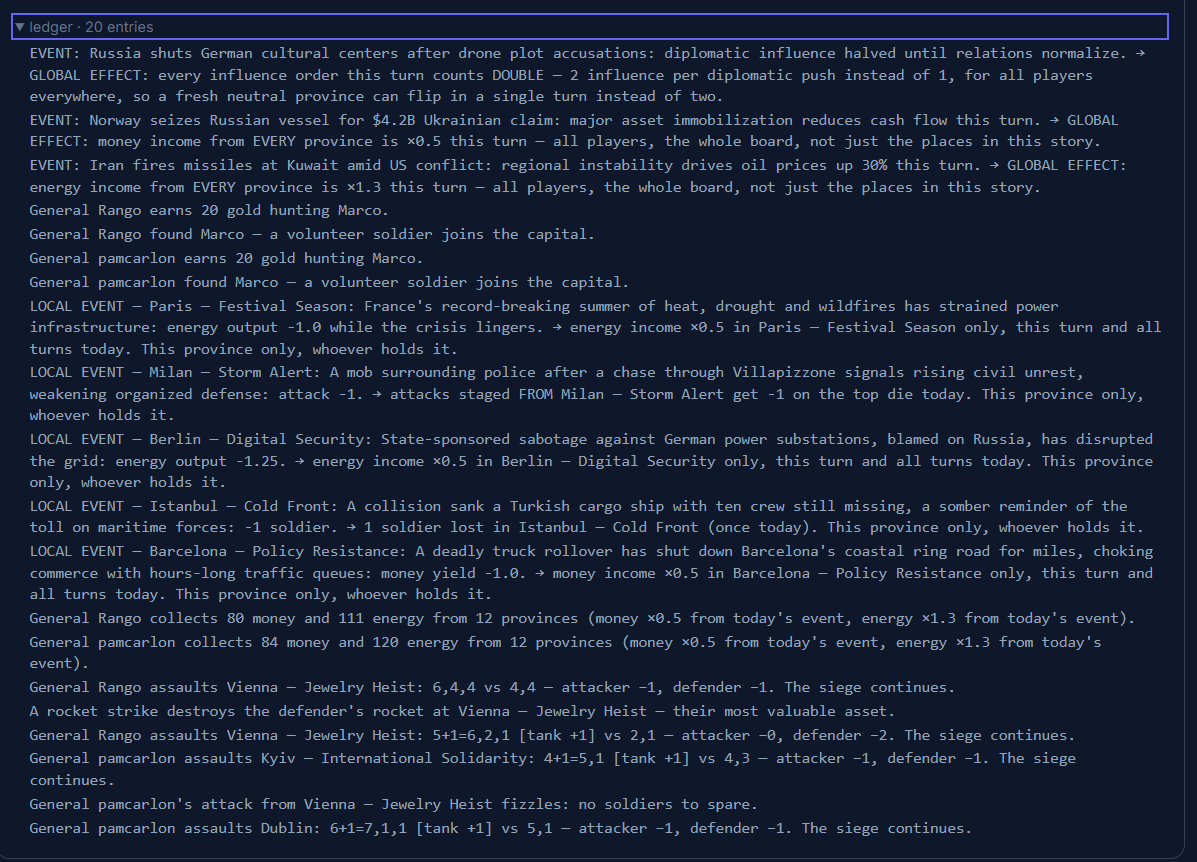
Every roll is provably fair: each turn’s random seed is committed as a hash before anyone orders and revealed after the turn resolves, so anyone can re-run the arithmetic. And under every dispatch sits the full mechanical ledger — every roll written out with its modifiers (“6+2=8”, and where the +2 came from), every capture, every order that fizzled and why, laid out phase by phase so you can see not just what happened but why it happened in that order.
The dispatches
After every turn, a war correspondent narrates what happened: your generals by name, the provinces by their real cities, the day’s real headlines woven through the fictional action. It is the part people screenshot. Above the board, a replay slider walks the whole match back and forth turn by turn.
Three ways to play
- Weekly — the classic. Launches Saturday, runs to Friday night’s scoring, one week of real news as its weather.
- Epic — the same daily rhythm, but the war runs one to four weeks. A month-long campaign lives through a month of changing event cards, and its dispatches become a running saga.
- Blitz — ignore the calendar. Pick 7, 15, or 30 turns, or no limit, and play a whole campaign in one sitting with friends.
Total conquest ends any match early. Otherwise the final scoring counts victory points: two per province, five per enemy capital you hold, plus your treasury. You can sit at as many tables as you like, and you can always leave a waiting table or resign a live war.
Getting a seat
Open Games → Enter the war room. Create a table for two to five players and share its six-letter code, or join an open one. And there is always at least one: Marco’s table, a standing public table anyone can join with a click. Marco hosts but never plays. It launches at the daily noon Pacific tick as soon as two or more generals are seated, and a fresh table opens behind it.
The games talk to each other
Reading the other games pays in Conquest. Find three or more of Marco’s clues today and your treasury earns +20 money. Find Marco himself and a volunteer soldier joins your capital. Call today’s Bullshit fake correctly and you bank +10 energy. A general who plays all three walks into the war room every day a little stronger — and a lot better informed.
Why games, and why these
The feed asks nothing of you, which is why it gives nothing back. A game asks you to know something. The hunt asks where. Bullshit asks exactly what. Conquest asks which stories are gathering force and how the world is moving. None of the three can be played on vibes. All three end every reveal with a link to the real story, so the learning is never a dead end, and Mappit’s guide Marco has read the full rulebook if anything puzzles you mid-game.
It is, we think, a genuinely better way to keep up: fifteen minutes a day that leave you knowing more instead of less, with a score to beat tomorrow.
Saturday is game day
All game clocks run on Pacific Time, and the week anchors on Saturday:
- 2:30 AM PT (5:30 AM ET) — a new Where’s Marco hunt publishes, as it does every morning.
- 8 AM PT (11 AM ET) — Bullshit round 1 of the new week unlocks with the Daily Digest. Start your streak here.
- 10 AM PT (1 PM ET) — the week’s Conquest board is drawn from the most-covered cities.
- Noon PT (3 PM ET) — Conquest tables launch. Be seated before noon to be in the first war of the week; Marco’s table needs only two generals.
Playing needs a free account; browsing the games pages doesn’t. Every game keeps Daily, Season, and All-Time leaderboards, and past editions stay browsable — a finished hunt reveals its whole trail, a past Bullshit week shows every answer.
Play the news at Mappit.ai. See you on the map Saturday!

